
Few things frustrate a Rockwall homeowner like a denial letter after a storm. The hail came through, the roof took the hit, the claim went in, and the carrier wrote back that the damage is wear and tear, or that it falls under the deductible, or that no storm damage was found at all. For many people that letter ends the conversation. It should not. A denied storm damage roof repair claim is a decision made on a single inspection, and inspections miss things, especially after a county-wide hail event when adjusters are moving across dozens of roofs a day.
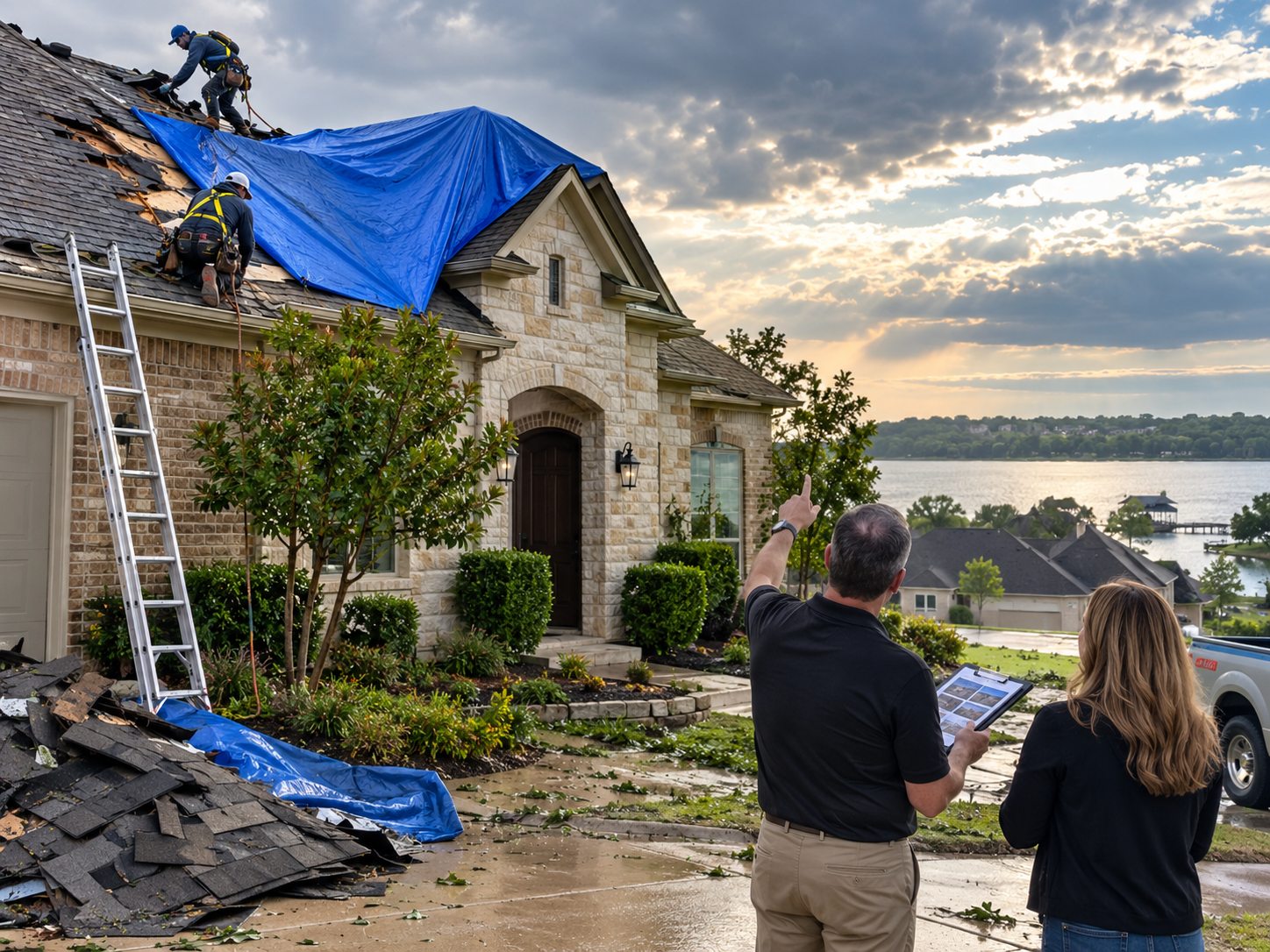
A denial rarely means the roof is fine. More often it means the adjuster drew a line in a particular place. The three lines that produce most Rockwall denials are a finding of wear and tear instead of storm damage, a scope of loss priced below the policy deductible, and a gap in documentation that leaves the damage unconnected to a dated storm. Each of these is a judgment call, and each can be revisited when the evidence is stronger than it was the first time.
The wear-and-tear line is the one that catches the most homeowners. Bruising and granule loss can read as age to an adjuster who did not size the hail or map the pattern, and an aging roof makes that call easier to reach. The problem is that a storm bruise and ordinary aging leave different marks, and telling them apart takes a closer look than a fast catastrophe inspection usually allows.
Not every disputed claim is a flat denial. Many are quietly underpaid, where the carrier approves the obvious slope and misses the rest. After a hail event that crosses Rockwall County, an adjuster handling a heavy daily load may document the front slope, see enough to approve a partial repair, and never test the back slopes where the same storm did the same work. The homeowner gets a check that covers part of the roof and assumes that is all the damage there was.
This is where a second set of eyes changes the outcome. A full re-inspection of every slope, with test squares and dated photos on each, often turns up hail hits the first pass did not record. Documented properly, that becomes a supplemental claim tied to the same date of loss, which is routine in North Texas hail work rather than an unusual ask.
SCR was founded in 1998 by Ken Nelson, who held an all-line adjuster license and worked catastrophic claims before moving to the roofing side. That history is the practical reason a denied Rockwall claim is worth a second look through SCR. The company re-inspects a roof the way a carrier does, knowing which evidence an adjuster needs to reverse a wear-and-tear call and how a scope of loss is built so it reflects the full damage rather than a partial slope.
A homeowner reading a denial letter is at a disadvantage, because the letter speaks the carrier's language and assumes the first inspection was complete. Someone who spent years writing those inspections reads the letter differently, sees where the scope fell short, and documents the gap in terms the carrier's own process recognizes. That is the difference between an appeal that goes nowhere and one a carrier takes seriously.
A request for reconsideration lives on its paperwork. The pieces that carry weight are a written damage report with the hail sized and the pattern mapped, date-stamped photos of each affected slope, a clear tie to a date of loss confirmed in National Weather Service or NOAA Storm Events records, and a scope of repair that matches the documented damage. SCR assembles that file after re-inspecting the roof, so the homeowner is not asking the carrier to simply take their word for it.
Tying the damage to a verifiable storm date matters more than homeowners expect. Rockwall County has a documented record of severe weather, from the 1.5-inch hail on April 20, 2023 to the 2-inch event on June 11, 2023 and the wind events of 2017 and 2024. Matching the roof damage to a confirmed event on one of those dates removes the carrier's easiest objection, that the damage cannot be linked to a covered storm.
Clarity matters here. SCR is a roofing contractor, not a public adjuster, and it does not negotiate the claim on the homeowner's behalf or act as the policyholder's representative in the way a licensed public adjuster would. What it does is inspect the roof, document the damage in writing, and provide that documentation to the homeowner and, with permission, to the carrier's adjuster. The homeowner remains the party to the claim. SCR supplies the evidence and the roofing work; the carrier makes the coverage decision.
That line is worth stating plainly because storm-chaser operators who appear after big events often blur it, promising to beat the insurance company or waive the deductible. Waiving a deductible on an insurance job is not legal in Texas, and promises to fight the carrier are a warning sign, not a service. Honest documentation and quality roofing work are what actually move a denied claim.
Two practical worries come up whenever a denial is on the table. The first is the deductible, which the homeowner owes regardless of the claim and which a legitimate contractor will never offer to absorb. The second is whether filing or appealing will lead to non-renewal. In Texas hail country, a single weather claim is common and treated differently from a pattern of claims, but multiple claims over a short span can affect renewal. A clear, well-documented claim that reflects the real damage, filed once and correctly, is the better position than a string of partial filings.
For a homeowner weighing whether to accept a denial, the cost of a second inspection is nothing, since SCR provides a free storm damage inspection. The downside of walking away is a roof that keeps aging around unaddressed storm damage until it leaks on the homeowner's own dollar.
Most Rockwall homeowners have never heard of a supplemental claim until they need one, yet it is one of the most common parts of a storm claim. The first estimate a carrier writes is based on what the adjuster saw from a fast inspection. Once a crew is on the roof doing approved work, they often find damage the first pass missed, cracked decking under a bruised slope, flashing the storm loosened, additional hail hits on a slope that was never tested. A supplemental claim documents that additional damage and submits it against the same date of loss, so the homeowner is made whole for the full scope rather than the partial one.
The supplement stands on the same evidence any claim does: written itemization, dated photos, and a clear link between the new damage and the original storm. SCR documents the additional findings as they surface and provides that record to the homeowner to submit. Because the company documents thoroughly on the first inspection, the gap between the carrier's initial scope and the real damage is visible early, which is often where a supplement begins rather than as a surprise mid-job.
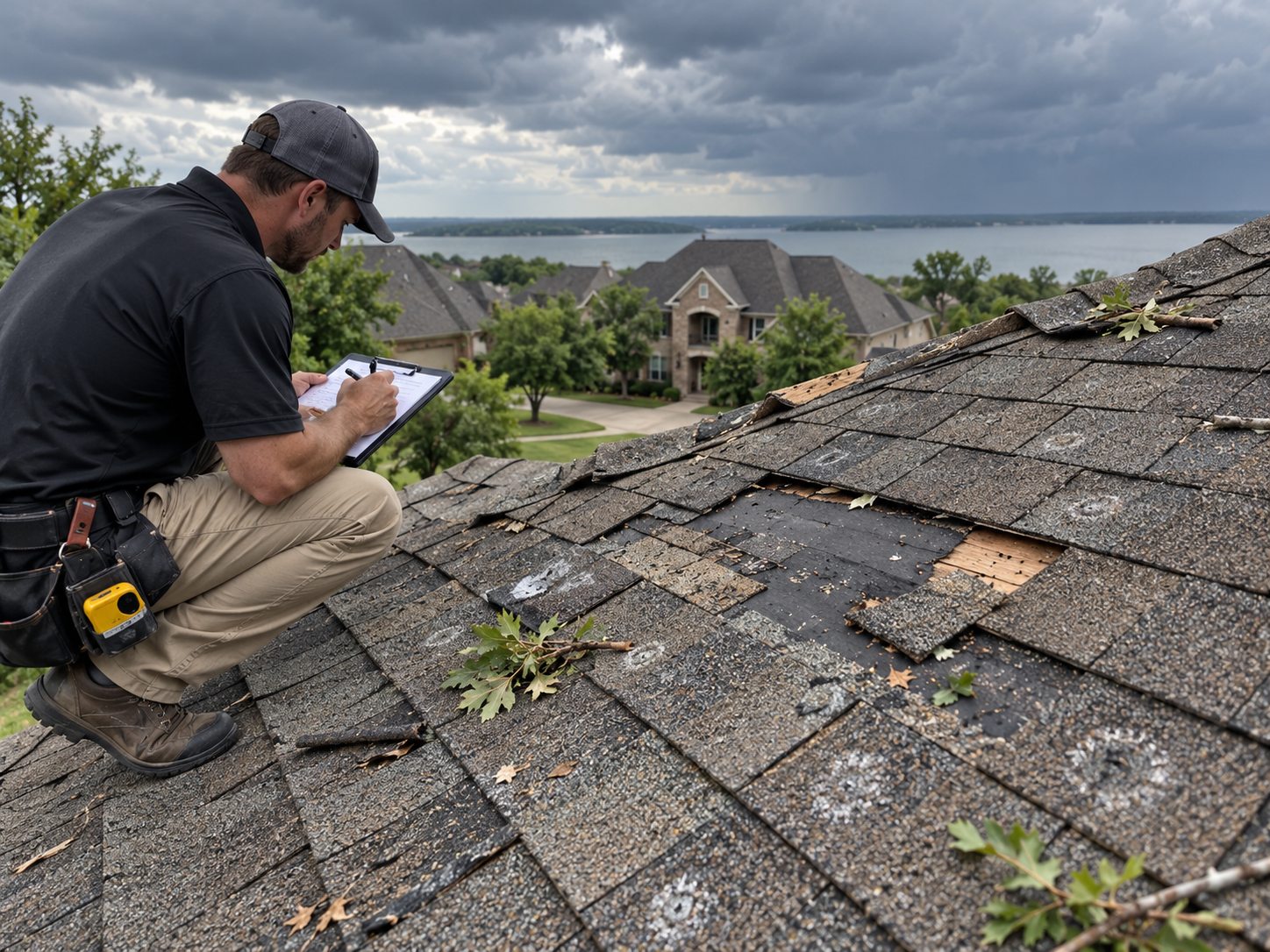
A homeowner holds more ground in a claim dispute when they understand their own policy, and two clauses matter most on a roof. The first is whether the policy pays replacement cost value or actual cash value. Replacement cost pays to put the roof back new, often in two parts with recoverable depreciation released after the work is done. Actual cash value pays the depreciated worth of an aging roof and leaves more on the homeowner. Knowing which one applies changes what a fair settlement looks like, and it changes whether a low payment is a denial to fight or simply the policy working as written.
The second is the deductible, which the homeowner owes on any approved claim and which no honest contractor will offer to absorb. A claim that comes back priced just under the deductible is not always wrong; sometimes the damage genuinely is minor. A re-inspection sorts that out by documenting whether the real scope exceeds the deductible or not. Reading these terms before a dispute keeps a homeowner from fighting the wrong battle, and from mistaking the policy's normal workings for a carrier acting in bad faith.
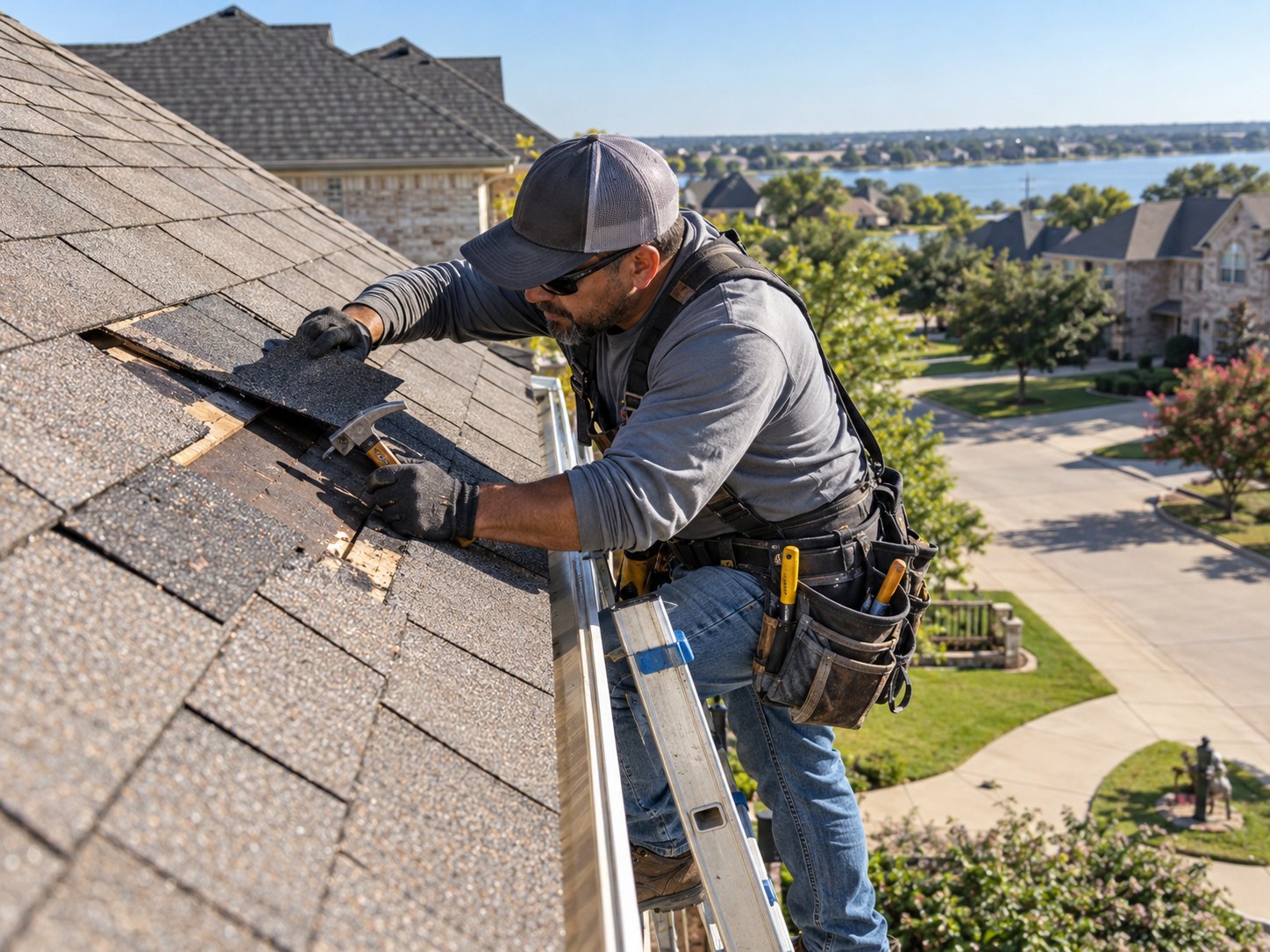
A second-opinion inspection after a denial is a full re-examination, not a glance to confirm a hunch. Every slope gets test squares and dated photos, the hail is sized from the marks, the pattern is mapped against the storm direction, and the decking and flashing are checked for damage the first adjuster never looked at. The point is to build a record detailed enough that a carrier reviewing it sees what its own inspector missed. Vague disagreement moves no carrier; documented, slope-by-slope evidence sometimes does.
That is where the former-adjuster background turns practical again. SCR knows the specific gaps a denial letter reveals, a slope never tested, a wear-and-tear call on damage that reads as impact, a scope that priced the front and ignored the back. The re-inspection is built to close those gaps in the terms a carrier's process recognizes. A homeowner gets a clear answer on whether the denial is worth challenging, and the documentation to challenge it if it is.

Honesty cuts both ways. Sometimes a denial is right, and a re-inspection confirms that a roof's problems are age and wear rather than a covered storm. An aging roof at the end of its service life, with granule loss from two decades of Texas sun and no tie to a dated hail event, does not become a claim because a homeowner wishes it would. SCR says so when that is the case, because the alternative, pushing a weak claim, wastes the homeowner's time and marks their claim history for nothing. A clear no is worth more than a false yes that a carrier denies anyway.
The practical takeaway for a Rockwall homeowner holding a denial letter is that the letter is a starting point, not a verdict. A free re-inspection sorts a wrongly denied claim from a correctly closed one, and either answer is worth having. A documented roof with a clear tie to a storm date gives a carrier a reason to reconsider, and an honest inspection that finds only wear saves the trouble of a claim that would fail anyway.
A denied claim can also affect a policy at renewal, which is one more reason to get a denial reviewed rather than simply refiling blind. A single, well-documented claim tied to a confirmed Rockwall County storm date reads very differently to a carrier than a string of partial filings. Getting the claim right once, with a complete written record of the damage, protects both the roof and the homeowner's standing with the insurer over the longer run. A clear record also makes the next claim easier, since the carrier can see the roof's history at a glance.
A denial letter is the carrier's first word, not its last. Rockwall County homeowners who believe a hail or wind claim was denied or underpaid can book a free re-inspection with SCR, Inc. General Contractors, get a written report of what the roof actually shows, and decide from there whether a reconsideration or supplemental claim is worth filing. To arrange a storm damage inspection, call (972) 839-6834 or visit scr247.com/storm-damage-roof-repair-rockwall-tx.
|
Rockwall, Texas
|
|
|---|---|
| City of Rockwall | |

Rusk Street in Rockwall
|
|

Logo
|
|

Location of Rockwall in Rockwall County, Texas
|
|
| Coordinates: 32°55′01″N 96°26′15″W / 32.91694°N 96.43750°W[1] | |
| Country | United States |
| State | Texas |
| County | Rockwall |
| Government
|
|
| • Type | Council-Manager |
| • City Council | Mayor: Trace Johannesen Mayor Pro Tem: Anna Campbell Tim McCallum Mark Moeller Clarence Jorif Sedric Thomas Dennis Lewis |
| • City Manager | Mary Smith |
| Area | |
|
• Total
|
29.97 sq mi (77.62 km2) |
| • Land | 29.47 sq mi (76.33 km2) |
| • Water | 0.50 sq mi (1.29 km2) 1.63% |
| Elevation | 561 ft (171 m) |
| Population
(2020)[3]
|
|
|
• Total
|
47,251 |
| • Density | 1,603/sq mi (619.0/km2) |
| Demonym(s) | Rockwaller, Rockwallite, Rockwallian |
| Time zone | UTC-6 (CST) |
| • Summer (DST) | UTC-5 (CDT) |
| ZIP codes |
|
| Area codes | 214, 469, 945, 972 |
| FIPS code | 48-62828[4] |
| GNIS feature ID | 2410982[1] |
| Website | www |
Rockwall is a city in the U.S. state of Texas and the county seat of Rockwall County.[5] The U.S. Census Bureau estimates that as of 2023, Rockwall's population is 52,918, up from 47,251 in the 2020 census.[6] The name Rockwall is derived from a naturally jointed geological formation, which has the appearance of an artificial wall.
The association of Paleo-Indian artifacts with extinct Pleistocene mammal remains in various archeological sites within the Texas Prairie-Savannah Region of eastern North Central Texas, including a site in Collin County, and Clovis points recovered from the Brushy Creek Clovis Site in Hunt County demonstrates that the Rockwall region was occupied by prehistoric Native American cultures at least as far back as 13,500 to 13,000 years ago.[7][8][9] More recently, the Rockwall region was occupied by Caddo Indians. Creek Indians moved to the area in the early 19th century. In 1925, Byron Khun de Prorok claimed that the wall was built by a prehistoric race, though this has been widely dismissed .[10][11][12] [13]
In 1851, the first Anglo-American settlers moved to the area, and wells were dug. During the digging, they found large underground rock walls that were initially believed to be man-made. Later study of the wall-like features by geologists and archaeologists found them to be jointed, natural sandstone dikes that had intruded Cretaceous marl.[11][12] The wall, when viewed from above, runs in long straight lines with angles that form a near perfect rectangle. The eastern wall has several deviations that run in straight lines with sharp angles, which would be unusual for a natural formation in an already unusual closed loop wall formation.
The town was established April 17, 1854 and named after these natural rock walls. While originally part of Kaufman County, in 1873, Rockwall County was formed with Rockwall being the county seat.[14]
According to the United States Census Bureau, the city has a total area of 31.6 square miles (82 km2), of which 22.3 square miles (58 km2) is land and 0.4 square miles (1.0 km2) (1.63%) is water.
Rockwall is on the eastern shore of Lake Ray Hubbard, approximately 20 miles northeast of Dallas. It is on state highways 205, 66 and 276, north of Interstate 30.[15]
The climate in this area is characterized by hot, humid summers and generally mild to cool winters. According to the Köppen Climate Classification system, Rockwall has a humid subtropical climate, abbreviated "Cfa" on climate maps.[16]
| Census | Pop. | Note | %± |
|---|---|---|---|
| 1880 | 215 | — | |
| 1890 | 843 | 292.1% | |
| 1900 | 1,245 | 47.7% | |
| 1910 | 1,136 | −8.8% | |
| 1920 | 1,388 | 22.2% | |
| 1930 | 1,074 | −22.6% | |
| 1940 | 1,318 | 22.7% | |
| 1950 | 1,501 | 13.9% | |
| 1960 | 2,166 | 44.3% | |
| 1970 | 3,121 | 44.1% | |
| 1980 | 5,939 | 90.3% | |
| 1990 | 10,486 | 76.6% | |
| 2000 | 17,976 | 71.4% | |
| 2010 | 37,490 | 108.6% | |
| 2020 | 47,251 | 26.0% | |
| 2024 (est.) | 53,547 | [17] | 13.3% |
| U.S. Decennial Census[18] | |||
As of the 2020 census, there were 47,251 people, 16,798 households, and 12,771 families residing in the city. The median age was 39.3 years, with 25.8% of residents under the age of 18 and 15.2% 65 years of age or older. For every 100 females there were 95.0 males, and for every 100 females age 18 and over there were 91.7 males age 18 and over.[19]
97.9% of residents lived in urban areas, while 2.1% lived in rural areas.[20]
There were 16,798 households in Rockwall, of which 38.6% had children under the age of 18 living in them. Of all households, 60.8% were married-couple households, 12.1% were households with a male householder and no spouse or partner present, and 23.0% were households with a female householder and no spouse or partner present. About 20.9% of all households were made up of individuals and 10.2% had someone living alone who was 65 years of age or older.[19]
There were 17,772 housing units, of which 5.5% were vacant. The homeowner vacancy rate was 2.3% and the rental vacancy rate was 8.1%.[19]
| Race | Number | Percent |
|---|---|---|
| White | 32,682 | 69.2% |
| Black or African American | 3,808 | 8.1% |
| American Indian and Alaska Native | 385 | 0.8% |
| Asian | 1,739 | 3.7% |
| Native Hawaiian and Other Pacific Islander | 49 | 0.1% |
| Some other race | 2,830 | 6.0% |
| Two or more races | 5,758 | 12.2% |
| Hispanic or Latino (of any race) | 8,649 | 18.3% |

According to the city's 2009 Comprehensive Annual Financial Report Fund Financial Statements, the city's various funds had $39.0 million in revenues, $42.2 million in expenditures, $32.3 million in total assets, $3.6 million in total liabilities, and $25.9 million in investments.[22]
The structure of the management and coordination of city services is:[23]
| Department | Director |
|---|---|
| City Manager | Mary Smith |
| Assistant City Manager | Joey Boyd |
| Director of Public Works/City Engineer | Amy Williams, PE |
| Director of Parks and Recreation | Travis Sales, MCPTM |
| Chief of Police | Ed Fowler |
| Fire Chief | Kenneth Cullins |
| Director of Planning | Ryan Miller, AICP |
The city of Rockwall is a voluntary member of the North Central Texas Council of Governments association, the purpose of which is to coordinate individual and collective local governments and facilitate regional solutions, eliminate unnecessary duplication, and enable joint decisions.
Rockwall is represented in the Texas Senate by Republican Bob Hall, District 2,[24] and in the Texas House of Representatives by Republican Justin Holland, House District 33.[25]
At the federal level, the two U.S. senators from Texas are Republicans John Cornyn and Ted Cruz; Rockwall is part of Texas's 4th congressional district, which is currently represented by Republican Pat Fallon.
The city is served by the Rockwall Independent School District. There are two public high schools in Rockwall: Rockwall High School and Rockwall-Heath High School. There are sixteen elementary schools and four middle schools in Rockwall.
The city is home to the Higher Education Center at Rockwall, which is part of the community college district, Collin College. The campus is the District's first campus outside of Collin County itself. Texas A&M University-Commerce holds classes at the center.
Rockwall is served by the following highways that run through the city:
 Interstate 30
 U.S. Highway 67 (runs concurrent with Interstate 30)
 State Highway 66
 State Highway 205
 State Highway 276
 Farm to Market 549
 Farm to Market 552
 Farm to Market 740
 Farm to Market 3549
 Farm to Market 1141
 Farm to Market 1139Farm to Market 740 (Ridge Road)
 Farm to Market 3097
 Farm to Market 550
Ralph M. Hall/Rockwall Municipal Airport is located two miles east of the city center and is used mostly by small general aviation aircraft.
The Dallas and Greenville Railway (which was quickly acquired by the Missouri–Kansas–Texas Railroad) originally served Rockwall.[26] The Dallas, Garland and Northeastern Railroad currently leases the line from Katy successor Union Pacific.
Rockwall offers many different sports complexes as well as activities. Airport Road boasts baseball fields, as well as the Landing Point complex containing the Texas International Fencing Center, zipline and dance facilities. The Rockwall Indoor Sports Expo is located on South 205. Lake Ray Hubbard has several boating marinas and is used for jet skiing.
Rockwall also offers 2 different Golf Courses [27] within 17 miles of the center of Rockwall.
cite web: CS1 maint: deprecated archival service (link)
| Cities |

|
|
|---|---|---|
| Footnotes |
‡This populated place also has portions in an adjacent county or counties
|
|
| International | |
|---|---|
| National | |
| Geographic | |
Many Texas policies allow about one year to file a hail claim, though terms vary, so timely documentation matters. Hail damage that is not claimed in time becomes the homeowner's problem when it finally causes a leak. SCR, with former insurance adjusters on staff, documents storm damage quickly to support a Wills Point homeowner's claim.
A local roofing contractor with a permanent presence is the safer choice. Out-of-state storm chasers follow hail events, do quick work, and leave, often with no one to honor a warranty. SCR has served North Texas since 1998 with local offices, so it is there before the storm and long after to stand behind the work.

