The open field of shingles is the part of a roof a homeowner sees, but it is rarely where the roof leaks. Water almost always finds its way in at the transitions and penetrations, at the flashing around a chimney, the rubber boot on a plumbing vent, or the valley where two roof planes meet. Understanding these weak points explains most Marietta roof leaks and shows why the right roof repair contractor looks there first. Summit Roofing repairs these failure points across Marietta and metro Atlanta.
These details matter because they are where the roof's watertight surface is interrupted. A field of shingles sheds water by overlap and gravity, but wherever something breaks that field, a pipe, a wall, a chimney, a change in slope, the roof depends on flashing and seals to keep water out. Those are the parts that fail first in the Georgia climate, and they are the parts that reward an experienced roof repair contractor who details them correctly rather than smearing sealant and hoping.
Flashing is the metal installed wherever the roof meets a wall, a chimney, a skylight, or another roof plane, and it is the single most common place a roof leaks. When flashing corrodes, lifts, pulls loose, or was poorly installed to begin with, water follows the gap it leaves and enters the structure. Repairing or replacing flashing is one of the most frequent jobs a roof repair contractor handles, and it is work that rewards experience, because the flashing has to be integrated with the shingles and underlayment in the right order to shed water.
Chimney flashing deserves particular attention on Marietta homes. A chimney interrupts the roof on all four sides, and it needs step flashing along the sides and a counterflashing set into the masonry to keep water out. This is a common leak source, because the flashing is complex and often done poorly by inexperienced hands. A roof repair contractor who knows chimney flashing can tell whether a leak is from failed flashing, failed sealant, or the masonry itself, and repair it so it lasts rather than leaking again next season.
Skylights and the places where a roof meets a vertical wall are two more transitions that leak. A skylight is essentially a hole in the roof with a frame, and it depends entirely on its flashing to stay watertight, so a leaking skylight usually has a flashing problem rather than a glass problem. Wall transitions, where a roof plane meets the side of a dormer or a second story, need step flashing woven into the shingles. A roof repair contractor addresses these transitions by correcting the flashing, not by caulking over the symptom, which is what makes the repair last.
The most common leak source that homeowners overlook is the pipe boot, the rubber collar that seals around a plumbing vent pipe where it passes through the roof. That rubber sits in full Georgia sun, and the heat and ultraviolet exposure crack and split it within years, opening a path for water right at the penetration. A homeowner with a mystery leak, often near a bathroom or kitchen, frequently has a failed pipe boot. Replacing it is a routine repair, and a roof repair contractor that knows Marietta roofs checks the boots as a matter of course.
Because pipe boots fail so predictably in the Southeast, they are worth watching before they leak. A boot that is cracked, hardened, or pulling away from the pipe is due for replacement whether or not it has leaked yet. Catching it during an inspection, rather than after water has stained a ceiling, is the difference between a quick repair and a repair plus interior damage. A roof repair contractor that inspects the boots along with the rest of the roof helps a homeowner stay ahead of this common failure.
A valley is the line where two roof planes meet, and it carries the combined water from both slopes, which makes it one of the hardest-working and most leak-prone parts of a roof. When a valley's flashing or shingle weave is damaged, worn, or clogged with debris, the concentrated water it channels finds any weakness. Georgia's heavy rain and the leaf and pine-straw debris that the region's tree cover drops make valley problems common around Marietta. A roof repair contractor repairs the valley so it channels water cleanly again.
Debris is a particular enemy of valleys in the metro Atlanta area. Heavy oak and pine cover drops leaves and pine straw that collect in valleys, trap moisture, and dam the water that should flow through, forcing it under the shingles. Keeping valleys clear is part of preventing leaks, and a roof repair contractor that clears and inspects them addresses a problem before it becomes a leak. When a valley has already failed, repairing it properly restores the channel that keeps a large part of the roof watertight.
What ties flashing, pipe boots, and valleys together is that each is a small part of the roof with an outsized consequence when it fails. A cracked boot the size of a fist, a foot of lifted flashing, or a clogged valley can let in enough water to rot decking and stain ceilings. That is why a roof repair contractor treats these details as the core of leak repair, and why catching them early through inspection saves a homeowner from the larger damage a neglected leak causes. Summit Roofing addresses these failure points with the experience they require.
Repairing these transitions well takes an experienced roof repair contractor, because the work is about integration, not just sealant. The flashing has to lap correctly with the shingles, the new boot has to seat properly, and the valley has to channel water as designed. A rushed repair that covers a symptom leaks again; a proper repair that addresses the cause lasts. Summit Roofing brings that experience as a local, GAF-certified and IKO-certified company, with in-house attention to the details that keep a Marietta roof watertight.
The edge of the roof is another place water tests the details. Drip edge is the metal that directs water off the roof and into the gutter rather than back under the shingles and against the fascia. When drip edge is missing, damaged, or was never installed, water can wick back at the eaves and rot the fascia and soffit. The perimeter of a roof is easy to overlook from the ground, but it is part of the same family of transition details that keep a roof watertight, and it is worth checking during any repair.
Rake edges, where the roof meets the gable ends, and the starter course along the eaves are part of this perimeter detailing too. Wind in a Georgia storm attacks the edges first, so sound edge detailing and fastening are what keep a roof from peeling back at the perimeter. Addressing these edges correctly is part of a repair that lasts rather than one that fails at the next high wind.
One of the clearest signs of a poor repair is a bead of caulk smeared over a symptom. Sealant has a place as part of a proper detail, but on its own, over a failed flashing or a cracked boot, it is a temporary cover that hides the problem rather than fixing it. Within a season or two, the sealant fails and the leak returns. A real repair addresses the underlying detail, integrating new flashing or a new boot with the surrounding roof. Summit Roofing repairs the cause rather than caulking the symptom, which is what makes a repair hold.
Because these transition details fail predictably, inspecting them catches problems before they leak. A cracked or hardened pipe boot, lifted flashing, a debris-clogged valley, or damaged drip edge is visible to a roofer who knows where to look, often before any water has come inside. A free inspection that checks each of these points is one of the simplest ways to stay ahead of a leak. Summit Roofing inspects the boots, flashing, valleys, and edges as a matter of course, because these are where Marietta roofs actually fail.
Skylights and chimneys deserve a closer look because they are two of the most common and most complex leak points on a Marietta roof. A skylight is a framed opening in the roof, and it depends entirely on its flashing kit to stay watertight, so a leaking skylight almost always has a flashing problem rather than a failure of the glass itself. Repairing it means addressing the flashing correctly, not caulking the frame. A roofer experienced with skylights knows the difference and repairs the actual cause.
Chimneys are harder still, because they interrupt the roof on four sides and need both step flashing along the sides and a counterflashing set into the masonry. Water can enter through failed flashing, failed sealant at the counterflashing, or gaps in the masonry itself, and telling these apart takes experience. A repair that addresses the wrong one leaks again. Summit Roofing diagnoses chimney leaks to their real cause and repairs the flashing so it sheds water, which is what keeps one of the roof's toughest details watertight for the long term.
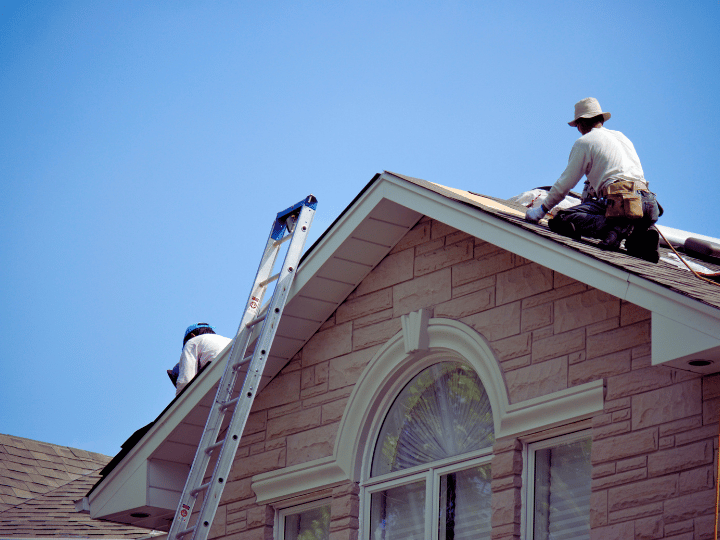
Severe weather is what turns a worn transition into an active leak. Cobb County sees frequent hail and high wind through its spring-to-late-summer storm season, with repeated hail and 60 mile-per-hour wind events across metro Atlanta in the summer of 2026, and that wind is what lifts flashing, tears at valley shingles, and drives rain sideways into any gap a worn boot or flashing has opened. A detail that held in calm weather can fail in the first strong storm. That is why inspecting the flashing, boots, and valleys after severe weather, before the next heavy rain arrives, catches the problem while it is still a simple repair.
Each of these transitions calls for its own repair, and doing the right one is what makes it last. A cracked boot is replaced, not caulked. Lifted or corroded flashing is reworked so it laps correctly with the shingles and underlayment. A damaged valley is repaired so it channels water cleanly, and a clogged one is cleared before it dams. Drip edge that has pulled loose is refastened so water leaves at the gutter rather than wicking behind it. Summit Roofing repairs each detail to its own standard rather than reaching for sealant as a shortcut, which is what keeps these failure points watertight through the next Georgia storm.
Summit Roofing is a locally owned and operated, licensed and insured, GAF-certified and IKO-certified roof repair contractor serving Marietta and metro Atlanta, with a repair-first approach, storm damage response, insurance-claim help, and free inspections. For the contractor that fixes flashing, pipe boots, and valleys the right way, contact Summit Roofing GA or call 770-545-5244 for a free inspection.
|
Marietta, Georgia
City of Marietta
|
|
|---|---|

Fountain in Marietta Square
|
|

Flag

Logo
|
|

Interactive map of Marietta, Georgia
|
|
| Coordinates: 33°57′12″N 84°32′26″W / 33.95333°N 84.54056°W | |
| Country |  United States United States |
| State |  Georgia Georgia |
| County | Cobb |
| Settled | Before 1824 |
| Legally recognized | December 19, 1834 |
| Incorporated | 1852 |
| Government
|
|
| • Mayor | Steve Tumlin (R) |
| • City Manager | William F. Bruton Jr. |
| Area | |
|
• Total
|
23.53 sq mi (60.94 km2) |
| • Land | 23.45 sq mi (60.74 km2) |
| • Water | 0.077 sq mi (0.20 km2) |
| Elevation
|
1,129 ft (344 m) |
| Population
(2020)
|
|
|
• Total
|
60,972 |
| • Density | 2,600/sq mi (1,003.8/km2) |
| 2018 estimate | |
| Time zone | UTC−5 (EST) |
| • Summer (DST) | UTC−4 (EDT) |
| ZIP Codes |
30006-08, 30060-69, 30090
|
| Area codes | |
| FIPS code | 13-49756[2] |
| GNIS feature ID | 0317694[3] |
| Website | www |

Marietta is a city in and the county seat of Cobb County, Georgia, United States.[4] At the 2020 census, the city had a population of 60,972, making it one of Atlanta's largest suburbs. Marietta is the fourth largest of the principal cities by population of the Atlanta metropolitan area.[5]
The origin of the name is uncertain. It is believed that the city was named for Mary Cobb, the wife of the U.S. Senator and Superior Court judge Thomas Willis Cobb. The county is named for Cobb.[6]
Homes were built by early settlers near the Cherokee town of Big Shanty (now Kennesaw) before 1824.[7] The first plot was laid out in 1833. Like most towns, Marietta had a square (Marietta Square) in the center with a courthouse. The Georgia General Assembly legally recognized the community on December 19, 1834.[7]
Built in 1838, Oakton House[8] is the oldest continuously occupied residence in Marietta. The original barn, milk house, smokehouse and well house remain on the property. The gardens contain the boxwood parterre from the 1870s. Oakton was Major General Loring's headquarters during the Battle of Kennesaw Mountain in 1864.[9]
Marietta was initially selected as the hub for the new Western and Atlantic Railroad and business boomed.[7] By 1838, roadbed and trestles had been built north of the city. In 1840, political wrangling stopped construction for a time and, in 1842, the railroad's new management moved the hub from Marietta to an area that became Atlanta. In 1850, when the railroad began operation, Marietta shared in the resulting prosperity.[7]
The businessman and politician John Glover arrived in 1848. A popular figure, Glover was elected mayor when the city incorporated in 1852.[7] Another early resident was Carey Cox, a physician, who promoted a "water cure" that attracted tourists to the area. The Cobb County Medical Society recognizes him as the county's first physician.[7]
The Georgia Military Institute was built in 1851 and the first bank opened in 1855.[7] During the 1850s, fire destroyed much of the city on three separate occasions.[7]
By the time the Civil War began in 1861, Marietta had recovered from the fires.[7]
In April 1862, James Andrews, a civilian working with the Union Army, came to Marietta, along with a small party of Union soldiers dressed in civilian clothing. The group spent the night in the Fletcher House hotel (later known as the Kennesaw House and now the home of the Marietta Museum of History) located immediately in front of the Western and Atlantic Railroad. Andrews and his men, who later became known as the Raiders, planned to seize a train and proceed north toward the city of Chattanooga, destroying the railroad on their way. They hoped, in so doing, to isolate Chattanooga from Atlanta and bring about the downfall of the Confederate stronghold. The Raiders boarded a waiting train on the morning of April 12, 1862, along with other passengers. Shortly after, the train made a scheduled stop in the town of Big Shanty, now known as Kennesaw. When the other passengers alighted for breakfast, Andrews and the Raiders stole the engine and the car behind it, which carried the fuel. The engine, called The General, and Andrews' Raiders had begun the episode now known as the Great Locomotive Chase.[7] Andrews and the Raiders failed in their mission. He and all of his men were caught within two weeks, including two men who had arrived late and missed the hijacking. All were tried as spies, convicted and hanged.[10]
General William Tecumseh Sherman invaded the town during the Atlanta campaign in summer 1864. In November 1864, General Hugh Kilpatrick set the town ablaze, the first strike in Sherman's March to the Sea.[7] Sherman's troops crossed the Chattahoochee River at a shallow section known as the Palisades, after burning the Marietta Paper Mills near the mouth of Sope Creek.
The Marietta Confederate Cemetery, with the graves of over 3,000 Confederate soldiers killed during the Battle of Atlanta, is located in the city.[11]
In 1892, the city established a public school system. It included a Marietta High School and Waterman Street School for white students. A school for black students was also created on Lemon Street. The state of Georgia did not provide a high school for black students until 1924, when Booker T. Washington High School opened in Atlanta, after decades of black citizens requesting educational resources.[12]

Leo Frank was lynched at 1200 Roswell Road just east of Marietta on August 17, 1915. Frank, a Jewish-American superintendent of the National Pencil Company in Atlanta, had been convicted on August 25, 1913, of the murder of one of his factory workers, 13-year-old Mary Phagan. The murder and trial, sensationalized in the local press, portrayed Frank as sexually depraved and captured the public's attention. An eleventh-hour commutation by Governor John Slaton of Frank's death sentence to life imprisonment because of problems with the case against him created great local outrage. A mob threatened the governor to the extent that the Georgia National Guard had to be called to defend him and he left the state immediately with his political career over. Another mob, systematically organized for the purpose, abducted Frank from prison, drove him to Marietta and hanged him. The leaders of the abduction included past, current and future elected local, county and state officials. There were two state legislators, the mayor, a former governor, a clergyman, two former Superior Court justices and an ex-sheriff. In reaction, Jewish activists created the Anti-Defamation League, to work to educate Americans about Jewish life and culture and to prevent anti-Semitism.[13][14]
The Big Chicken was constructed in Marietta in 1963.[15]
In 1963, Atherton's Drugstore, a store on Marietta Square, exploded on Halloween night, killing 6 people and injuring 23 others.[16][17]
Located near the center of Cobb County, between Kennesaw to the northwest and Smyrna to the southeast. U.S. Route 41 and State Route 3 run through the city northeast of downtown as Cobb Parkway, and Interstate 75 runs parallel to it through the eastern part of Marietta, with access from exits 261, 263, 265, and 267. Downtown Atlanta is 20 miles (32 km) to the southeast, and Cartersville is 24 miles (39 km) to the northwest.
According to the United States Census Bureau, Marietta has a total area of 23.2 square miles (60.0 km2), of which 23.1 square miles (59.8 km2) is land and 0.077 square miles (0.2 km2), or 0.38%, is water.[5]
Marietta has a humid subtropical climate (Köppen climate classification Cfa).
Marietta falls under the USDA 7b Plant Hardiness zone.[18]
| Climate data for Marietta, Georgia | |||||||||||||
|---|---|---|---|---|---|---|---|---|---|---|---|---|---|
| Month | Jan | Feb | Mar | Apr | May | Jun | Jul | Aug | Sep | Oct | Nov | Dec | Year |
| Record high °F (°C) | 80 (27) |
80 (27) |
89 (32) |
93 (34) |
96 (36) |
101 (38) |
104 (40) |
104 (40) |
99 (37) |
92 (33) |
86 (30) |
80 (27) |
104 (40) |
| Mean daily maximum °F (°C) | 52 (11) |
56 (13) |
64 (18) |
73 (23) |
80 (27) |
87 (31) |
89 (32) |
88 (31) |
83 (28) |
73 (23) |
64 (18) |
54 (12) |
72 (22) |
| Mean daily minimum °F (°C) | 30 (−1) |
33 (1) |
39 (4) |
46 (8) |
55 (13) |
64 (18) |
68 (20) |
67 (19) |
60 (16) |
48 (9) |
39 (4) |
32 (0) |
48 (9) |
| Record low °F (°C) | −12 (−24) |
−2 (−19) |
7 (−14) |
21 (−6) |
32 (0) |
40 (4) |
50 (10) |
48 (9) |
30 (−1) |
22 (−6) |
9 (−13) |
−4 (−20) |
−12 (−24) |
| Average precipitation inches (mm) | 4.86 (123) |
5.36 (136) |
5.07 (129) |
3.93 (100) |
4.12 (105) |
4.07 (103) |
5.10 (130) |
4.35 (110) |
4.10 (104) |
3.42 (87) |
4.30 (109) |
4.49 (114) |
54.63 (1,388) |
| Source: [19] | |||||||||||||
| Census | Pop. | Note | %± |
|---|---|---|---|
| 1870 | 1,888 | — | |
| 1880 | 2,227 | 18.0% | |
| 1890 | 3,384 | 52.0% | |
| 1900 | 4,446 | 31.4% | |
| 1910 | 5,949 | 33.8% | |
| 1920 | 6,190 | 4.1% | |
| 1930 | 7,638 | 23.4% | |
| 1940 | 8,667 | 13.5% | |
| 1950 | 20,687 | 138.7% | |
| 1960 | 25,565 | 23.6% | |
| 1970 | 27,216 | 6.5% | |
| 1980 | 30,805 | 13.2% | |
| 1990 | 44,129 | 43.3% | |
| 2000 | 58,748 | 33.1% | |
| 2010 | 56,579 | −3.7% | |
| 2020 | 60,972 | 7.8% | |
| 2025 (est.) | 63,574 |  |
4.3% |
| U.S. Decennial Census[20] 1850–1870[21] 1870–1880[22] 1890–1910[23] 1920–1930[24] 1940[25] 1950[26] 1960[27] 1970[28] 1980[29] 1990[30] 2000[31] 2010[32] 2025[33] |
|||
As of the 2020 census, Marietta had a population of 60,972. The median age was 34.7 years. 20.5% of residents were under the age of 18 and 13.6% of residents were 65 years of age or older. For every 100 females there were 92.2 males, and for every 100 females age 18 and over there were 89.8 males age 18 and over.[34][35]
100.0% of residents lived in urban areas, while 0.0% lived in rural areas.[36]
There were 24,865 households in Marietta, of which 27.4% had children under the age of 18 living in them. Of all households, 36.2% were married-couple households, 21.8% were households with a male householder and no spouse or partner present, and 34.9% were households with a female householder and no spouse or partner present. About 33.9% of all households were made up of individuals and 10.5% had someone living alone who was 65 years of age or older. There were 13,788 families residing in the city.[34]
There were 26,644 housing units, of which 6.7% were vacant. The homeowner vacancy rate was 1.7% and the rental vacancy rate was 7.5%.[34]
| Race | Number | Percent |
|---|---|---|
| White | 27,472 | 45.1% |
| Black or African American | 17,886 | 29.3% |
| American Indian and Alaska Native | 735 | 1.2% |
| Asian | 1,782 | 2.9% |
| Native Hawaiian and Other Pacific Islander | 49 | 0.1% |
| Some other race | 6,894 | 11.3% |
| Two or more races | 6,154 | 10.1% |
| Hispanic or Latino (of any race) | 12,528 | 20.5% |
At the 2010 census, there were 56,641 people and 22,261 households.[2] The population density was 2,684.1 per square mile (1,036.3/km2). There were 25,227 housing units at an average density of 1,152.6 per square mile (445.0/km2). The racial make-up was 52.7% White, 31.5% African American, 0.1% Native American, 3.0% Asian, 0.1% Pacific Islander, 9.1% from other races and 3.3% from two or more races. Hispanic or Latino people of any race were 20.6% of the population.
There were 23,895 households, of which 27.8% had children under 18 living with them, 35.4% were married couples living together, 13.8% had a female householder with no husband present, and 45.5% were non-families. 32.8% of all households were made up of individuals, and 6.9% had someone living alone who was 65 years of age or older. The average household size was 2.39, and the average family size was 3.05.
22.4% of the population were under the age of 18, 14.1% from 18 to 24, 39.4% from 25 to 44, 15.7% from 45 to 64 and 8.3% were 65 years of age or older. The median age was 30 years. For every 100 females, there were 101.3 males. For every 101 females age 18 and over, there were 100.3 males.
Incorporated as a village in 1834 and as a city in 1852, the city of Marietta is organized under a form of government consisting of a mayor, city council, and city manager. The city council is made up of representatives elected from each of seven single-member districts within the city, and a mayor elected at-large.
The city council is the governing body of the city with authority to adopt and enforce municipal laws and regulations. The mayor and city council appoint members of the community to sit on the city's various boards and commissions, ensuring that a broad cross-section of the town is represented in the city government.
The city council appoints the city manager, the city's chief executive officer. The council-manager relationship is comparable to that of a board of directors and CEO in a private company or corporation. The city manager appoints city department heads and is responsible to the city council for all city operations. The city council also appoints the city attorney, who serves as the city's chief legal officer; and the city clerk, who maintains all the city's records.
Terms of office are for four years, and the number of terms a member may serve is unlimited. There are seven councilmen, each representing a separate ward.[37]
| Name | Term of office |
|---|---|
| John Hayward Glover | 1852 |
| Joshua Welch | 1853 |
| W. T. Winn | 1854 |
| I. N. Heggie | 1855 |
| N. B. Knight | 1856 |
| J. W. Robertson | 1857 |
| R. W. Joyner | 1858 |
| I. N. Heggie | 1859 |
| Samuel Lawrence | 1860–1861 |
| J. A. Tolleson | 1862 |
| W. T. Winn | 1863 |
| H. M. Hammett | 1864[a] |
| C.C. Winn | 1865[b] |
| A. N. Simpson | 1866–1868 |
| G. W. Cleland | 1869 |
| William H. Tucker | 1870–1873 |
| Humphrey Reid | 1874 |
| William H. Tucker | 1875 |
| Edward Denmead | 1876–1877 |
| Humphrey Reid | 1878 |
| Joel T. Haley | 1879 |
| Edward Denmead | 1880–1883 |
| Enoch Faw | 1884 |
| W. M. Sessions | 1885 |
| Edward Denmead | 1886–1887 |
| Thomas W. Glover | 1888–1893 |
| R. N. Holland | 1894–1895 |
| D. W. Blair | 1896–1897[c] |
| W. M. Sessions | 1898–1899 |
| T. M. Brumby Sr. | 1900–1901 |
| Joe P. Legg | 1902–1903 |
| John E. Mozley | 1904–1905 |
| E. P. Dobbs | 1906–1909 |
| Eugene Herbert Clay | 1910–1911 |
| J. J. Black | 1912–1913 |
| E. P. Dobbs | 1914–1915 |
| James R. Brumby Jr. | 1916–1922[d] |
| Gordon B. Gann | 1922–1925[e] |
| E. R. Hunt | 1926–1927 |
| Gordon B. Gann | 1928–1929 |
| T. M. Brumby Jr. | 1930–1938[f] |
| L. M. Blair | 1938–1947[g] |
| Sam J. Welsch | 1948–1955 |
| C. W. Bramlett | 1956–1959 |
| Sam J. Welsch | 1960–1963 |
| L. H. Atherton Jr. | 1964–1969 |
| James R. Hunter | 1970–1973 |
| J. Dana Eastham | 1974–1981 |
| Robert E. Flournoy Jr. | 1982–1985 |
| Vicki Chastain | 1986–1989 |
| Joe Mack Wilson | 1990–1993[h] |
| Ansley L. Meaders | 1993–2001[i] |
| William B. Dunaway | 2002–2009 |
| Steve Tumlin | 2010–present |
In 2022 the median household income was $67,589 and the per capita income was $40,767. About 12.8% of the population were below the poverty line.[38]
Dobbins Air Reserve Base on the south side of town and a Lockheed Martin manufacturing plant are among the major industries in the city. The Lockheed Georgia Employees Credit Union is based in Marietta.[39]
According to Marietta's 2021 Annual Comprehensive Financial Report,[40] the top employers within the city are :
| # | Employer | Employees |
|---|---|---|
| 1 | WellStar Kennestone Hospital | 5,055 |
| 2 | Dobbins Air Reserve Base | 2,000 |
| 3 | Cobb County Public Safety | 1,600 |
| 4 | Tip Top Poultry | 1,400 |
| 5 | Cobb County Board of Education | 1,368 |
| 6 | Marietta City Schools | 1,266 |
| 7 | Cobb County Government | 1,171 |
| 8 | XPO, Inc. Last Mile | 750 |
| 9 | City of Marietta | 716 |
| 10 | Cobb Energy Membership Corp (EMC) | 640 |
The city operates Marietta Power under the auspices of the Board of Lights & Water.
Interstate 75 and U.S. 41 run through the eastern part of the city. State routes 3, 5, and 120 also run through Marietta.
CobbLinc, Marietta/Cobb County's Transit System and Xpress GA buses serve the city.
The CSX freight trains between Atlanta and Chattanooga (Western & Atlantic Subdivision) still run a block west of the town square, past the 1898-built former railroad depot (now the Visitor Center).[41]
Into the 1950s the Louisville and Nashville Railroad operated the Midwest-Florida trains, the Cincinnati-Florida Flamingo and the Chicago-Florida Southland, which made daily stops in Marietta Depot. Into the 1960s, the L&N's Chicago & St. Louis-Florida trains, Dixie Flyer and Dixie Limited also made stops there. The final train was the L&N's St. Louis, Missouri - Evansville, Indiana - Atlanta Georgian, which ended service on April 30, 1971. (Until 1968, the train also had a northern leg from Evansville to Chicago.)[42]
The Marietta Daily Journal is published in the city.[43]
East Marietta National Little League won the 1983 Little League World Series, defeating the team from Barahona, Dominican Republic in the world championship.
All of the public schools in Marietta proper are operated by the Marietta City Schools (MCS), while the remainder of the schools in Cobb County, but outside the city limits, is operated by the Cobb County School District, including all of the county's other cities. MCS has one high school, Marietta High School, grades 9–12; a middle school, Marietta Middle School, grades 7 and 8; Marietta Sixth Grade Academy; and several elementary schools: A.L. Burruss, Dunleith, Hickory Hills, Lockheed, Marietta Center for Advanced Academics, Park Street, Sawyer Road, and West Side.[44] Many residents of Marietta attend Cobb County public schools, such as Joseph Wheeler High School, Sprayberry High School, Alan C. Pope High School, and Walton High School. These schools are known to compete fiercely in athletics, especially basketball, as both Wheeler and Marietta High School frequently produce D-1 players. The town of Marietta is also home to the Walker School, a private pre-kindergarten through 12th-grade school. Walker competes in the Georgia High School Association Class A (Region 6) athletic division while Marietta and Wheeler compete in Class AAAAAA (Regions 4 and 5, respectively).
The school system employs 1,200 people. MCS is an International Baccalaureate (IB) World School district. In 2008, MCS became only the second IB World School district in Georgia authorized to offer the IB Middle Years Program (MYP) for grades 6–10. MCS is one of only a few school systems nationwide able to provide the full IB (K-12) continuum.[45]
The Marietta Campus of Kennesaw State University, formerly known as Southern Polytechnic State University (SPSU) before being merged into Kennesaw State, and Life University are located in Marietta, serving more than 20,000 students in more than 90 programs of study.


The city has six historic districts, some on the National Register of Historic Places (these include Northwest Marietta, Whitlock Avenue, Washington Avenue, and Church-Cherokee Streets).[46] The city's visitor center is located in the historic train depot.
Downtown is the town square and former location of the county courthouse. The square is the site of several cultural productions and public events, including a weekly farmers' market.
The Marietta Players perform semi-professional theater year-round. The historic Strand Theatre has been renovated back to its original design and features live theatre, concerts, classic films, and other events.[12] The Marietta/Cobb Museum of Art is in the old Post Office building.
The Marietta History Center exhibits the history of the city and county. The center is home to thousands of artifacts including items from Marietta residents and businesses. The Marietta Gone with the Wind Museum is located in the Historic Brumby Hall and houses a private collection of memorabilia related to Gone with the Wind, both the book and the film.[12] The William Root House Museum and Garden is the oldest wood-frame house still standing in Marietta, built c. 1845. Once owned by William Root, one of Marietta's earliest citizens and merchants whose drugstore was located in the Square.[47]
The Big Chicken, which currently sits on top of a KFC restaurant, has been a landmark on U.S. 41 and Roswell Road since 1963.[48]
Miramax Films and Disney filmed scenes of the 1995 movie Gordy here. The 2014 film Dumb and Dumber To filmed a scene in the Marietta Square.[49]
The city includes the Kennesaw House, one of only four commercial buildings in Marietta not burned to the ground in Sherman's March to the Sea. The Kennesaw House is home to the Marietta History Center[50] which tells the history of Marietta and Cobb County.
 |
This section needs more citations. (April 2025)
|
Marietta has two sister cities.[70]
cite web: CS1 maint: deprecated archival service (link)cite web: CS1 maint: deprecated archival service (link)cite web: |access-date= requires |url= (help)CS1 maint: deprecated archival service (link)cite web: Check |url= value (help)Born on 9/3/75 in Marietta, Georgia. Pop singer.
At least two books have been produced chronicling the history of the city in pictures:


|
Places adjacent to Marietta, Georgia
|
|
|---|---|
|
 |
|||||
|
||||||
|
||||||
| Cities |

|
|
|---|---|---|
| CDPs | ||
| Unincorporated communities |
||
| Footnotes |
‡This populated place also has portions in an adjacent county or counties
|
|
| International | |
|---|---|
| National | |
| Geographic | |
| Other | |
On the Newport Beach coast, standard grade cedar with light maintenance sits toward the lower end of its range, while a top grade roof with consistent maintenance lasts considerably longer. Maintenance is the biggest factor, so annual cleaning and a preservative treatment every few years protect the higher end of that range.
They can. In HOA-governed communities such as Newport Coast, the association's architectural rules may set roofing requirements that sit on top of the state fire code. It is worth confirming both the HOA rules and your insurance requirements before choosing cedar, since both can shape what is allowed.
Many California carriers now require fire-retardant-treated assemblies or decline real wood entirely. If your carrier will not write cedar, a Class A rated composite shingle keeps the cedar look while satisfying the code and the insurer. Confirming your carrier's position before the project avoids a non-renewal surprise later.


